Public Procurement Intelligence (BPIL)
Turning ten years of Finnish public spending data into evidence-backed buyer intelligence.
- invoice rows, 2016–2026 (€98.8 bn)
- 23.5 M
- invoice rows, 2016–2026 (€98.8 bn)
- of spend linked to a valid Business ID
- 97.1%
- of spend linked to a valid Business ID
- name-matching precision after fixing failure modes
- 95.4 → 99.2%
- name-matching precision after fixing failure modes
Overview
R&D under Barmo, my side business. A research codebase that asks whether fragmented Finnish public data can tell a supplier who buys what, from whom and how that is changing, and later, whether purchasing can be forecast better than simple recurrence. It combines purchase invoices from OpenProcurement.fi, EU tender notices from TED, the PRH company register and Statistics Finland into one DuckDB warehouse with provenance back to the source file row.
Approach
Claims are earned in order: correct data, then descriptive intelligence, then baselines, then ML, then opportunity signals. Each step can falsify the idea. The ML evaluation protocol, including a point-in-time dataset in which no feature may use data from after the prediction date, was written down before any model was trained.
Entity resolution experiment
Can supplier rows without a Business ID be matched to the company register by name? I hid the known ID for 100,121 name variants and measured the rule against them.
- Normalised name only: 95.4% precise.
- Requiring the same legal form: 98.5%. This fixed cross-border collisions such as a Swedish AB matching a Finnish Oy.
- Also requiring the company name to be valid during the spend period: 99.2%. 88% of the remaining errors were recycled names, where a dissolved company's name had been registered again by a new company.
- Without these guards, about 5% of name-resolved relationships would have been silently wrong.
What the data actually says
- 21.5% of procurement spend goes to other public bodies and 8% to the organisation itself, so naive "top supplier" rankings mislead.
- Only central government (about 58 buyers over 129 months) forms a dense, long panel. Municipal coverage is a handful of organisations, not a national dataset.
- Source files are rewritten in place without versioning, so the pipeline keeps its own dated snapshots with checksums.
- One city's 2020 data is missing entirely despite being declared as covered. The gap is flagged and masked rather than treated as zero spend.
Status
The data foundation is done, with 58 tests, and per-buyer profiles are being generated. Baselines and ML are next. Prediction is still unproven: for stable categories, simple recurrence may well be enough.
Related projects
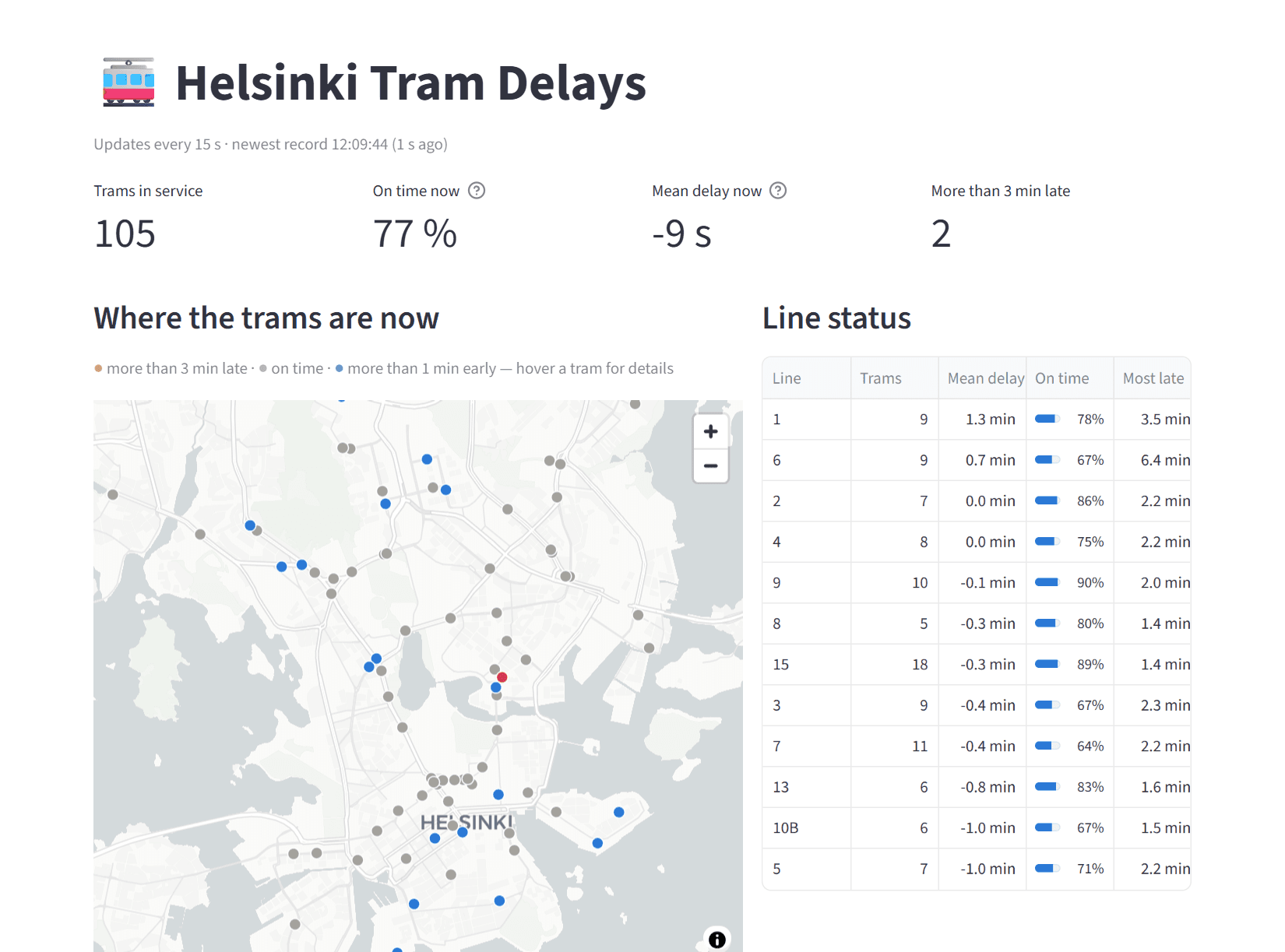
Helsinki Tram MLOps
Live tram tracking and 5-minute delay forecasts for every tram in Helsinki.
FinTax
Retrieval-first research on Finnish tax law: find the right provision before generating anything.